AI SDRs: Automating Follow-Up Emails

AI-powered Sales Development Representatives (SDRs) are reshaping sales outreach by automating tasks like follow-up emails, lead qualification, and meeting scheduling. Unlike traditional tools that rely on generic templates, AI SDRs craft personalized messages by analyzing data from CRMs, LinkedIn, and more. They adapt follow-ups based on prospect behavior, ensuring timely and relevant communication.
Key takeaways from the article:
- Efficiency Boost: AI SDRs handle hundreds of prospects daily, compared to 8–10 by human SDRs.
- Improved Results: Companies report up to 50% higher open rates and increased response rates (e.g., 12% to 28%).
- Lead Conversion: AI SDRs ensure no lead is ignored, reducing sales cycle time and increasing meeting bookings.
- Tools like Agent Frank: Automate multi-channel outreach, refine messaging via real-time analytics, and handle objections seamlessly.
AI SDRs save time, improve personalization, and drive better sales outcomes, making them vital for modern sales teams.
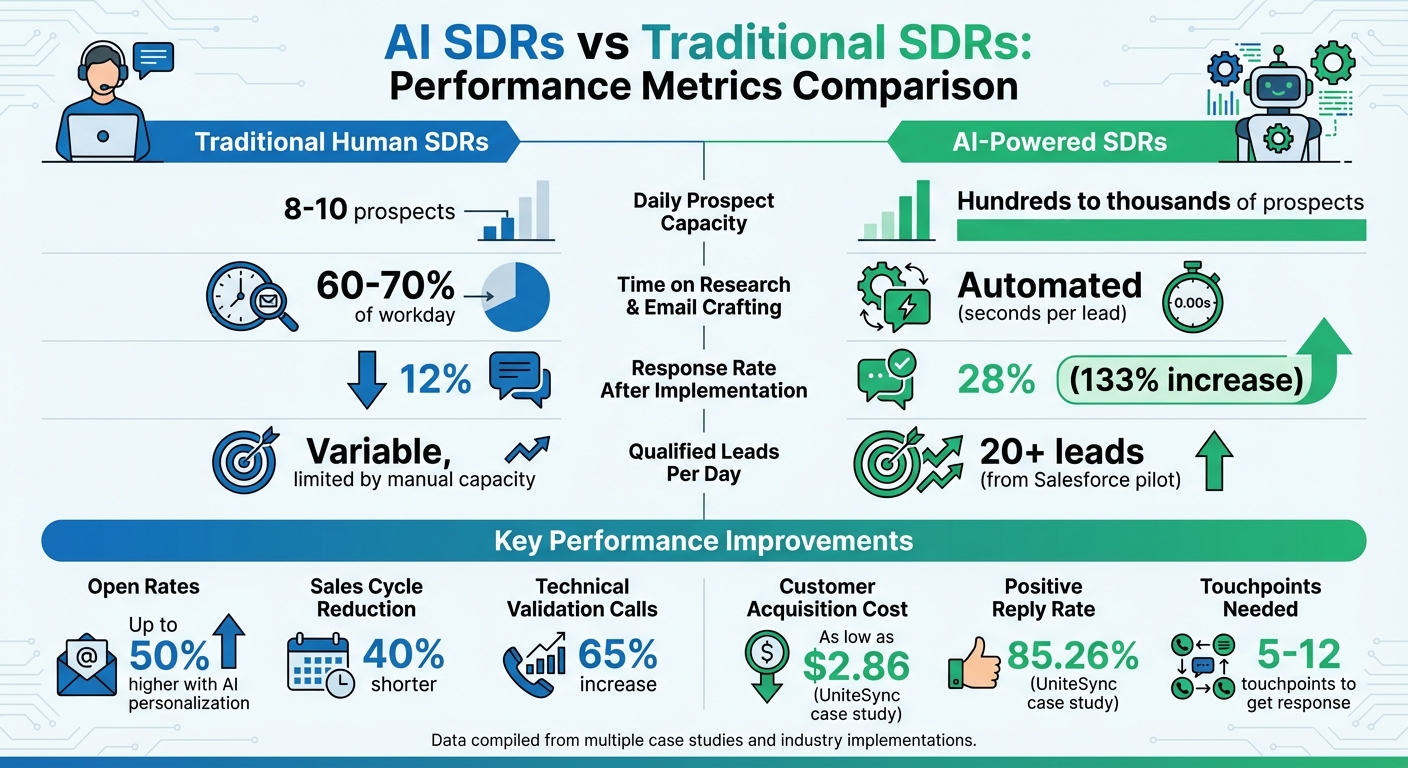
AI SDRs vs Traditional SDRs: Performance Metrics Comparison
What AI SDRs Are and How They Handle Follow-Up Emails
An AI SDR (Artificial Intelligence Sales Development Representative) is essentially a digital assistant designed to take on early-stage sales tasks like prospecting, qualifying leads, and outreach. Think of it as a virtual sales rep that handles the repetitive but critical legwork - gathering prospect details, crafting tailored emails, sending follow-ups, and even scheduling meetings. This kind of automation ensures consistent engagement through personalized and timely follow-ups.
Unlike traditional tools that rely on generic templates and fixed schedules, AI SDRs operate with a lot more nuance. They pull data from sources like CRMs, LinkedIn, company websites, and even the latest news to create messages that are tailored to specific events, challenges, or achievements.
When it comes to follow-ups, AI SDRs track how prospects interact with previous emails - whether they open, click, or reply - and adjust the next steps accordingly. For instance, if someone opens an email but doesn't respond, the AI might follow up with a fresh angle on the original topic. On the other hand, if a prospect responds with "not interested", the AI can analyze that and send a reply that aligns with the prospect's needs or objections.
This technology acts as a game-changer for sales teams. By processing vast amounts of data in seconds, AI SDRs can engage with hundreds or even thousands of leads at once, a feat that manual SDRs - who typically manage 8–10 prospects daily - simply can't match.
How AI SDR Technology Works
AI SDRs rely on three main technologies: machine learning, natural language processing (NLP), and automation systems.
- Machine learning sifts through prospect data to predict which types of messages will resonate. For example, it might notice that startups are more likely to respond to emails referencing recent funding rounds.
- NLP enables the AI to craft subject lines and email content that sound natural and include personalized details. It can even handle multiple languages while maintaining the same level of customization.
- The automation layer ties everything together. It schedules emails, manages multi-channel outreach across platforms like email and LinkedIn, and triggers follow-up actions based on how prospects behave. For example, if someone shows interest, the AI might send a calendar link for scheduling a meeting. If not, it adjusts the timing and tone of the next follow-up.
This combination of technologies ensures that follow-ups are not only timely but also highly relevant, making them more effective.
Why Follow-Up Emails Matter in Sales
Follow-up emails play a crucial role in sales. Most prospects ignore the first email, and research suggests it often takes 5–12 touchpoints to get a response. That’s where AI SDRs shine. Their ability to adapt messaging based on a prospect's behavior ensures that each follow-up feels timely and relevant, keeping your outreach on their radar without coming across as pushy.
Effective follow-ups convey persistence and professionalism. They show that you're genuinely interested in solving the prospect's challenges, rather than just trying to close a quick deal. By automating this process, AI SDRs make sure every lead gets the attention it deserves.
For example, Salesforce's internal pilot found that reps using AI SDRs could handle 20 qualified leads per day after the AI pre-qualified them. This led to higher win rates and more closed deals.
"Our CAC is currently $2.86, and we expect it to decrease even further. We're currently onboarding 4 to 5 new music creators every day. We truly believe in what you're building at Salesforge. Your guidance on how to scale and reach the right customers has allowed us to grow efficiently, bringing in strong results without excessive effort. It's made a real difference." - Carlos Palop, CEO, UniteSync
Another example comes from a manufacturing company that used an AI SDR to match equipment specifications with facility requirements while drafting precise outreach messages. This approach not only pre-qualified leads but also addressed initial objections via email, resulting in a 65% increase in technical validation calls and a 40% reduction in sales cycle time.
Benefits of Automating Follow-Up Emails with AI SDRs
Higher Efficiency and Productivity
Automating follow-up emails with AI SDRs transforms how sales teams allocate their time. Traditional SDRs spend a staggering 60–70% of their workday on research and crafting emails, which limits them to sending only 8–10 personalized emails daily. In contrast, AI SDRs can manage these tasks for hundreds - or even thousands - of prospects simultaneously. This shift allows human reps to focus on what they do best: engaging in live conversations and closing deals.
Consider this: A mid-market SaaS company with 6 SDRs implemented an AI SDR solution and saw their response rates jump from 12% to 28%. By automating routine tasks, their SDRs were able to dedicate more time to building meaningful relationships.
Salesforce's internal pilot program further highlights the impact. Reps using AI SDR agents handled around 20 qualified leads per day after leveraging AI for prequalification. This increase in productivity led to higher win rates and more closed deals compared to teams not using AI. For U.S.-based teams, where SDR costs are high, such efficiency gains directly enhance profitability without requiring additional hires.
This newfound productivity also paves the way for deeper personalization, ensuring every outreach feels tailored and relevant to the recipient.
Better Personalization at Scale
One of the biggest challenges in sales is balancing personalization with speed. AI SDRs tackle this head-on, enabling outreach that feels custom-crafted without sacrificing volume. Tools like Agent Frank, for example, pull data from CRMs, LinkedIn profiles, company websites, and even recent news to craft messages that align with each prospect's unique context - whether it’s a recent funding announcement, a new product release, or a career move.
This level of personalization pays off. AI-powered emails can achieve up to 50% higher open rates compared to generic templates. Plus, the technology continuously learns from engagement data, refining strategies over time by analyzing which subject lines, messaging styles, and send times resonate most. The result? Follow-ups that not only scale but also improve in quality with every interaction.
Industries across the board are proving that detailed, automated outreach drives stronger engagement, accelerates sales cycles, and builds better connections with prospects.
Higher Lead Conversion Rates
When it comes to lead conversion, consistency is key - and AI SDRs excel in this area. They ensure no lead is overlooked, responding instantly, qualifying prospects systematically, and routing them to the right sales rep at the perfect time. This is critical, especially when research shows it can take 5–12 touchpoints to elicit a response.
Take UniteSync, for example. By leveraging AI SDRs, they achieved an impressive 85.26% positive reply rate and reduced their customer acquisition cost (CAC) to $2.86. This efficiency now enables them to onboard 4 to 5 new music creators daily.
But the benefits don’t stop at reply rates. AI SDRs are equipped to handle objections, adapt messaging based on prospect behavior, and even automate next steps - like sending out a calendar link when a prospect expresses interest. This seamless process keeps leads engaged and steadily moving through the sales funnel, resulting in more booked meetings and, ultimately, increased revenue.
How Agent Frank Automates Follow-Up Sequences in Salesforge
Agent Frank, the AI Sales Development Representative (SDR) within Salesforge, takes care of the entire outbound sales process - from identifying potential clients to scheduling meetings - without requiring manual input. It can analyze responses, craft tailored replies, and adjust messaging based on the situation. For instance, if an email doesn’t get a response, Agent Frank might follow up with a LinkedIn message before sending another email that includes a relevant case study. This multi-channel approach has been shown to increase response rates by as much as 50%.
The system is designed to learn continuously. By tracking metrics like open rates, replies, and conversions, it runs A/B tests to refine follow-up sequences. For leads showing higher engagement, it may shorten the follow-up timeline, while for others, it adjusts the tone and timing of messages. This smart automation simplifies lead qualification and ensures a seamless multi-channel outreach process.
Setting Up Agent Frank for Lead Qualification and Personalization
To get started, connect your lead sources - such as your CRM system, LinkedIn, or a CSV file - and define your qualification criteria. These can include factors like job role, company size, industry, or recent activities. Agent Frank evaluates leads based on their engagement and intent before advancing them through the pipeline.
The personalization engine takes things further by gathering real-time data from LinkedIn profiles, company websites, press releases, industry news, and even social media updates. For example, if a prospect has recently been promoted, Agent Frank might send a message like, "Congratulations on your new VP role! I imagine you're exploring tools to help scale your team." While a human SDR might manage this level of customization for only a handful of leads each day, Agent Frank can handle it at scale, reaching hundreds of prospects simultaneously.
You can also provide brand guidelines and messaging frameworks to ensure that Agent Frank communicates in a way that aligns with your company’s tone. The AI creates personalized follow-ups tailored to each lead’s profile, whether it’s a technical buyer needing detailed ROI insights or an executive looking for strategic outcomes. To start, you can use supervised mode to review messages before they’re sent. Over time, as the system is fine-tuned, you can transition to full automation. This setup ensures every follow-up matches the quality of manual efforts while being far more efficient.
Setting Up Multi-Channel Follow-Ups (Email + LinkedIn)
To implement a multi-channel strategy, integrate your email accounts and LinkedIn profiles into Salesforge. You can then define sequence rules, such as sending a LinkedIn connection request or comment if an initial email goes unanswered. After that, Agent Frank follows up with a contextual email. This approach improves engagement.
Salesforge’s Primebox™ simplifies things further by consolidating responses from both email and LinkedIn into a single interface, so you never miss a prospect’s reply.
Handling Objections and Automating Responses
Agent Frank uses natural language processing (NLP) to classify responses into categories like positive, neutral, or negative, and then triggers the appropriate follow-up actions. For example, if a prospect raises a pricing concern, the AI might send an ROI calculator along with a case study. If timing is the issue, the prospect is moved into a nurture sequence. Over time, the AI learns which responses are most effective at securing meetings.
When handling budget objections, Agent Frank might highlight how another company in the same industry achieved a 40% reduction in sales cycle time, making the investment easier to justify. If a prospect expresses interest, the AI qualifies them with targeted questions and schedules meetings using integrated calendar tools. For more complex situations, it seamlessly hands off the conversation to a human sales representative.
Step-by-Step Guide to Setting Up AI-Driven Follow-Up Automation
Setting up AI-driven follow-up automation is simpler than you might think. It boils down to three key steps: connecting your data sources, launching email sequences, and activating follow-ups. Let’s dive in, starting with connecting your leads and data.
Step 1: Connect Your Leads and Data Sources
First, log into Salesforge and navigate to the Integrations/Data Sources section. Here, you can connect your preferred CRM systems like Salesforce, HubSpot, or Pipedrive. If you’re not using a CRM, no problem - upload a CSV file or link tools like LinkedIn Sales Navigator and Google Sheets.
Once connected, input your API credentials and map essential fields such as name, email, company, and role. To ensure everything is working smoothly, test the connection with a sample of 10–20 leads. This step eliminates the need for manual data entry, allowing Agent Frank to instantly access all prospect information. What used to take 30–60 minutes per lead can now be done in seconds.
Make sure your data is formatted correctly (e.g., using U.S. conventions like 1,000.00 for thousands) and complies with GDPR regulations. This process doesn’t just save time - it also drives results. For instance, one SaaS team reported a jump in response rates from 12% to 28% after freeing up their SDRs to focus on conversations instead of research.
Step 2: Create and Launch AI-Powered Email Sequences
Next, head to the Set up sequences section in Salesforge to create your first AI-driven campaign. Agent Frank uses natural language processing to generate personalized content tailored to your prospect data. It pulls insights from sources like LinkedIn profiles, company news, funding updates, and industry trends.
To make your emails stand out, use dynamic placeholders like {recent_funding} or {role_pain_points}. For example, if you’re targeting CFOs, the AI might highlight ROI benefits, whereas messages for founders could emphasize seamless integration. This level of personalization can increase open rates by as much as 50% compared to standard templates.
Start in supervised mode to monitor the AI’s performance, then switch to full automation when you’re confident. The platform also supports multilingual campaigns, so you can reach prospects in their native language while keeping your brand voice consistent.
Step 3: Turn On Follow-Up Automation and Track Performance
Finally, activate follow-up automation. With AI-driven response tracking, Agent Frank dynamically adjusts follow-ups in real time. For instance, if a prospect opens your email but doesn’t reply, the system might automatically send a LinkedIn message to re-engage them.
Monitor metrics like open rates, reply rates, and meeting conversions through Salesforge’s analytics dashboard. Tim Savage, CEO of Net New Solutions, noted that high open rates helped fine-tune his team’s calling campaigns.
To ensure your emails land in the primary inbox, use the Warmforge integration to maintain deliverability. The AI also runs A/B tests to identify the most effective subject lines and messaging strategies. In a Salesforce pilot program, reps using AI tools managed 20 qualified leads per day and achieved better win rates compared to their non-AI counterparts.
Comparing Salesforge Agent Frank with Competitors
When it comes to evaluating AI SDR platforms, it's all about understanding how they stack up in features, pricing, and multi-channel capabilities. Let’s dive into how Salesforge's Agent Frank compares to the competition.
Feature Comparison: AI Personalization, Scalability, and Automation
Agent Frank is designed as an autonomous AI SDR, managing every step of the outreach process - from finding prospects to securing meetings. It draws on a proprietary data lake, powered by Gen AI and machine learning, and offers unlimited mailboxes and LinkedIn senders without the need for seat-based pricing.
On the other hand, Reply.io's Jason AI SDR automates lead generation and multi-channel outreach. It covers email, LinkedIn, WhatsApp, SMS, and calls, with options for autopilot and copilot modes to enhance meeting bookings.
Salesforge shines in multi-channel outreach by seamlessly integrating email and LinkedIn into conditional sequences. Its Primebox™ feature consolidates replies from both channels, using AI to analyze and organize them. Reply.io goes a step further in channel variety, adding WhatsApp, SMS, and calls, with integration options via Zapier.
For email deliverability, Salesforge includes Warmforge, offering free, unlimited email warm-ups as part of every subscription. Meanwhile, Reply.io provides over 30 deliverability tools, including email health checks, Google Postmaster integration, and mailbox warm-ups.
Here’s a snapshot of how the two platforms compare:
| Feature | Salesforge Agent Frank | Reply.io Jason AI SDR |
|---|---|---|
| AI Functionality | Fully autonomous outreach (prospecting, personalization, follow-ups, meeting booking) with proprietary Gen AI & ML | AI-driven sequences for lead generation, multi-channel outreach, and meeting booking |
| Multi-Channel | Email + LinkedIn with unlimited senders and Primebox™ for AI-powered reply unification | Email, LinkedIn, WhatsApp, SMS, calls, and Zapier integrations |
| Scalability | Unlimited mailboxes and LinkedIn senders, no seat-based pricing | Unlimited mailboxes and warm-ups, unlimited users in AI SDR plans |
| Deliverability | Free unlimited warm-up with Warmforge and mailbox rotation | 30+ deliverability tools, including Email Health Checker and free warm-ups with each mailbox |
| G2 Rating | 4.6 | 4.6/5 from 1,480 reviews |
Michael Greenberg, Owner of Business Radio X, shared his experience with Reply.io:
"With Reply I have about a 60% hit rate with heavily customized AI emails."
Now, let’s take a closer look at how their pricing structures differ.
Pricing and Cost Comparison
Salesforge and Reply.io take very different approaches to pricing. Salesforge requires booking a demo to receive specific pricing for Agent Frank, but it does offer a 14-day free trial. A standout feature is its unlimited mailboxes and LinkedIn senders, which can be a cost-effective solution for growing teams.
Reply.io, on the other hand, offers clear and tiered pricing. Jason AI SDR plans start at $500/month (billed annually) for 1,000 active contacts and 2 LinkedIn accounts. Higher-tier plans go up to $1,500/month (billed annually) for 5,000 active contacts and 10 LinkedIn accounts, with enterprise options available. For human-led plans, pricing begins at $49/user/month for email-only outreach or $89/user/month for multi-channel setups, with add-ons like LinkedIn automation at $69/month/account and calls/SMS automation at $29/month/account.
The key distinction lies in LinkedIn outreach. Salesforge includes unlimited LinkedIn senders as part of its platform, while Reply.io limits the number of LinkedIn accounts in its AI SDR tiers or charges extra for additional accounts. If your team plans to scale LinkedIn outreach extensively, Salesforge’s unlimited model offers more flexibility. On the flip side, Reply.io’s transparent, tiered pricing might work better for teams seeking predictability.
Both platforms enjoy strong user ratings, with each earning a 4.6 score on G2.
Best Practices for AI SDR Follow-Up Email Deliverability
Getting your follow-up emails delivered successfully boils down to building trust with email providers. When tools like Agent Frank or other AI SDRs send out hundreds of follow-ups daily, even small mistakes can hurt your campaign. But with the right approach, you can maintain a strong sender reputation and ensure your messages land in the right inbox.
Using Email Warm-Up with Tools Like Warmforge
Email warm-up is the starting point for reliable deliverability. When you connect a new mailbox or domain, providers like Gmail and Outlook are cautious at first. Tools like Warmforge help establish trust by gradually boosting your sender reputation. They do this by using a network of established Google Workspace and Microsoft 365 mailboxes to send and receive emails on your behalf.
For instance, teams at ChannelCrawler and UniteSync saw impressive results using Salesforge and Warmforge. ChannelCrawler’s Co-Founder, Jake Kitchiner, shared:
"But the warm-up process, spintax, and inbox management are all winners for us."
Similarly, UniteSync’s CEO, Carlos Palop Moliner, noted:
"cold email only works when it lands", emphasizing how Warmforge’s tools helped them onboard 4 to 5 new music creators daily.
To get started, warm up new mailboxes at least two to three weeks before launching your outreach. Begin with a low volume - around 10–20 emails daily - and gradually ramp up over several weeks. Warmforge automates this process and tracks mailbox health using metrics like Heat Score™, helping you address potential issues before they hurt your campaigns.
Once your technical setup is solid, focus on crafting high-quality email content.
Writing High-Quality and Compliant Email Content
Even with a well-warmed mailbox, poorly written emails won’t perform. AI-generated follow-ups need to feel human, remain concise, and avoid spam triggers. Stick to 3–7 sentences with a single, clear value proposition. Personalize your opening lines - mention a recent funding round, a job change, or a LinkedIn post - rather than relying on generic intros. Research shows that AI-driven personalization can boost open rates by up to 50%, which improves sender reputation as recipients engage positively.
Avoid spam signals like excessive punctuation, all caps, or misleading prefixes such as "RE:" or "FWD:" unless they’re genuinely relevant. For U.S.-based recipients, compliance with CAN-SPAM regulations is non-negotiable. This means your emails must:
- Clearly identify the sender
- Include a valid physical postal address
- Use honest subject lines
- Offer an easy opt-out option, which tools like Agent Frank must honor promptly.
In follow-ups, reference previous interactions - e.g., "Just circling back on my note from last week about [specific pain point]" - instead of recycling the same template. Repeating irrelevant messages can lead to spam complaints. Tools like Lavender can evaluate your emails for clarity, tone, and spam risk before sending them.
Using Analytics to Improve Campaign Performance
Tracking the right metrics is essential for gauging the success of your deliverability efforts. Key metrics to monitor include open rate, click-through rate, reply rate, bounce rate, and spam complaints. For B2B cold outreach, healthy benchmarks are:
- Open rates: 40–60%
- Reply rates: 3–10%
- Hard bounces: under 3–5%
- Spam complaints: under 0.1–0.2%
If your bounce rate climbs above 2–3%, it’s a sign of poor list quality and calls for immediate data cleanup. Similarly, even a slight increase in spam complaints (over 0.1–0.2%) indicates the need to adjust frequency, targeting, or messaging - or possibly pause sends from the affected mailbox.
A case study from Relevance AI highlighted how an SDR team improved response rates from 12% to 28% by refining personalization and targeting based on analytics.
Experiment with A/B testing for subject lines, send times, and follow-up sequences. Test different U.S. weekdays or times (like mid-morning versus afternoon) and compare shorter sequences (3–5 touches) to longer ones (7–9 touches). Use the results to improve engagement without triggering complaints. Platforms like Salesforge provide detailed analytics, making it easy to identify what works and adapt Agent Frank’s templates accordingly.
Conclusion: The Future of Sales Outreach with AI SDRs
AI-powered SDRs are changing the game for follow-up automation. By taking over time-consuming tasks like prospecting, research, sequencing, and responding to routine messages, they free up human SDRs to focus on high-value activities like discovery calls and closing deals. Companies incorporating AI into their workflows have already seen boosts in win rates and an increase in closed deals.
The data speaks for itself - performance metrics from various implementations show noticeable improvements in response rates, win rates, and overall efficiency.
Looking ahead, AI agents are set to handle entire outreach cadences on their own, from the first touchpoint to scheduling meetings. With deeper integration into CRMs and data platforms, these systems will utilize real-time intent signals to make smarter decisions. They’ll also improve multichannel coordination, seamlessly managing outreach across email, LinkedIn, SMS, and in-app messaging. Plus, learning-based sequences will adapt on the fly, tailoring touchpoints based on how prospects engage.
For U.S. sales leaders looking to tap into these benefits, the first step is to evaluate current follow-up performance. Metrics like reply rates, meetings per 100 contacts, and time spent per lead can help establish a baseline. From there, it’s crucial to set clear parameters - think messaging guidelines, ideal customer profiles, and rules for objection handling - and define the point where AI hands off to human reps. Tools like Salesforge and Agent Frank make it easier to implement AI-driven follow-ups while ensuring email deliverability with integrated solutions like Warmforge and Primebox™, all of which support the multichannel strategies discussed earlier.
FAQs
How do AI SDRs make follow-up emails more personalized compared to traditional tools?
AI SDRs elevate personalization by leveraging advanced algorithms to deeply analyze each lead's unique needs, interests, and behaviors. Rather than sticking to static templates or making manual tweaks, these tools generate dynamic, customized messages that genuinely resonate with recipients.
Take Agent Frank, for instance. This AI SDR uses data-driven insights to craft emails that speak directly to a lead's specific challenges and preferences, all while keeping the tone conversational and natural. The result? A time-saving process that boosts engagement and response rates, making follow-ups not just easier but also far more impactful and scalable.
How do AI SDRs efficiently manage a high volume of leads?
AI SDRs use cutting-edge automation tools to manage large volumes of leads with ease. One standout feature is AI-powered personalization, which customizes messages for individual recipients, creating a more tailored approach. Another key aspect is multi-channel sequencing, allowing outreach to happen across multiple platforms, keeping leads engaged wherever they are.
They also come equipped with tools like unlimited mailbox management and automated reply handling, simplifying communication processes. To ensure smooth operations, features such as email warm-up systems and reply consolidation tools help maintain high deliverability and keep responses well-organized. These capabilities make AI SDRs an effective choice for scaling outreach efforts without sacrificing efficiency.
How do AI SDRs help boost lead conversion rates in sales?
AI-powered SDRs (Sales Development Representatives) are transforming how businesses manage lead conversion by automating personalized follow-ups. They ensure every message aligns with the prospect's needs and is sent at the perfect time, keeping leads engaged and boosting the chances of getting a response or booking a meeting.
These tools use AI to sift through data, customize outreach for each lead, and take over repetitive tasks like follow-ups. This allows sales teams to dedicate their energy to more critical, high-value conversations. The result? A more efficient sales process that saves time and drives better outcomes.